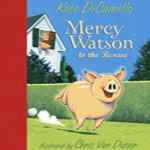
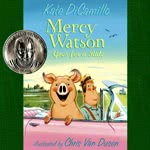
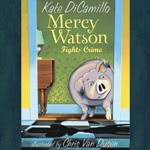
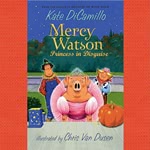
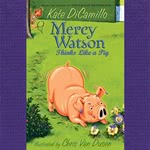
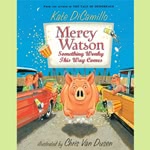
The same pig, family, neighbors, appetites, misunderstandings, and comic rhythms return - but each book needs a new problem.
6 core booksGrades 1-3Catalogue reviewed
You are the teacher.
Use what works. Change what doesn’t. Make it yours.
Teaching purpose
Students study how a series balances familiarity and surprise. Across six Mercy Watson stories, recurring characters, settings, appetites, misunderstandings, and comic patterns create recognition, while each new problem changes how those familiar pieces are used.
Recommended grade band: Grades 1-3
The Big Question
What has to stay the same - and what has to change - for a series to keep working?
Source and confidence boundary
Titles, book IDs, authors, formats, and listed reading levels were checked against the updated TumbleBookLibrary Book_List.xlsx. Grade-band recommendations are instructional recommendations for the set, not catalogue claims about every individual title.
Standards status
This curated reading sequence is not itself a region-specific standards claim. Review the documentary status on any linked lesson plan.
Why it belongs: A larger comic situation gathers familiar characters and running expectations into another escalating problem.
Unique contribution: It closes by asking students to identify the series formula without reducing every book to the same story.
AskWhat could you predict because you know the series - and what could you not predict?
Optional extensions
Mercy Watson (Playlist)Book ID 6694Kate DiCamillo · Catalogue reviewedWhy optional: Use for browsing the series as a collection and letting students identify recurring visual or title patterns.
Bink and Gollie: Don't You Need a New Pair of Socks?Book ID 6899Kate DiCamillo & Alison McGhee · Catalogue reviewedWhy optional: A useful comparison with another early-reader series associated with DiCamillo: different characters, different rhythm, similar need to balance repetition and change.
Selection note: The core is limited to six titles so every book has a distinct job. The point of an author/series set is not to catalogue everything held; it is to make recurring craft, structure, or instructional design visible.
Across-the-set teaching moves
Track recurring characters, places, phrases, objects, and habits.
Before each new book, make one series-based prediction and one plot-based question.
Distinguish a recurring trait from a repeated plot.
Ask what a new genre flavor or special event adds without changing the series identity.
After the sixth title, describe the series formula in a way that still leaves room for surprise.
Book-to-book connections
To the Rescue + Goes for a Ride: Compare the baseline series world with the first major variation.
Fights Crime + Princess in Disguise: Compare two books that borrow recognizable genre or event conventions.
Thinks like a Pig + Something Wonky This Way Comes: Compare a recurring character trait used in a focused problem with a larger ensemble escalation.
Culminating discussion
Write a 'recipe' for a Mercy Watson book: list the elements that usually return, then explain what a new book would have to change so it did not feel like a copy.
Teacher look-fors
Names recurring series elements with evidence.
Distinguishes character continuity from plot repetition.
Explains how a new problem changes familiar material.
Makes predictions from series knowledge without assuming every book must follow exactly the same events.
Existing-set duplication check
Closest existing Text Set: Kate DiCamillo: Relationships Across Her Books
What overlaps: Both include DiCamillo's recurring interest in relationships and comic character worlds.
Why this set is genuinely different: The DiCamillo author set compares themes across very different works; this set studies series construction itself - how repeated characters and conventions create expectations across six closely related books.