Sharing, comparing, timing, measuring, grouping, and scoring become ordinary problems that mathematics can settle.
6 core booksGrades 1-3Catalogue reviewed
You are the teacher.
Use what works. Change what doesn’t. Make it yours.
Teaching purpose
Students compare how Stuart J. Murphy's MathStart stories make mathematics useful inside recognizable situations. The sequence deliberately crosses several domains so students notice a larger habit: the story creates a reason to quantify, compare, organize, or calculate.
Recommended grade band: Grades 1-3
The Big Question
When does an everyday problem become a math problem?
Source and confidence boundary
Titles, book IDs, authors, formats, and reading levels were checked against the updated TumbleBookLibrary Book_List.xlsx supplied for this build. Grade-band recommendations are instructional recommendations for the set, not catalogue claims about every individual title.
Standards status
This curated reading sequence is not itself a region-specific standards claim. Review the documentary status on any linked lesson plan.
For every book, ask students to name the problem before naming the math. Then ask what information has to be counted, measured, compared, or organized to solve it.
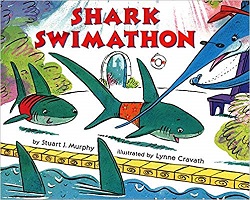
Why it belongs: A swimathon turns totals, progress, and repeated quantities into a problem the characters need to monitor.
Unique contribution: It closes with multiple pieces of information that must be combined and interpreted rather than simply counted once.
AskWhat should the swimmers keep track of, and why?
Optional extensions
Bigger, Better, Best!Book ID 8476Stuart J. Murphy · Catalogue reviewedWhy optional: An extension for comparison and measurement language; catalogue reading level is not supplied.
Grizzly Gazette, TheBook ID 8519Stuart J. Murphy · Catalogue reviewedWhy optional: A Grade 3 extension for organizing and interpreting numerical information.
Selection note: The core is limited to six titles so every book has a distinct job. The point of an author/series set is not to catalogue everything held; it is to make recurring craft, structure, or instructional design visible.
Across-the-set teaching moves
Name the everyday problem before identifying the operation or concept.
Ask what quantity is being counted, compared, measured, partitioned, or tracked.
Use manipulatives or quick sketches to recreate the story's mathematical model.
Change one number and ask whether the same strategy still works.
After solving, explain the answer in the language of the story rather than stopping at a numeral.
Book-to-book connections
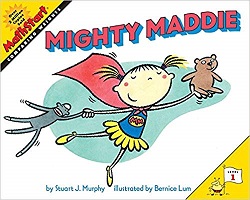
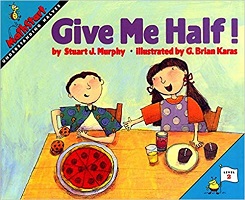
Mighty Maddie + Give Me Half!: Compare measurement language with equal partition.
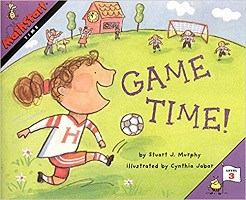
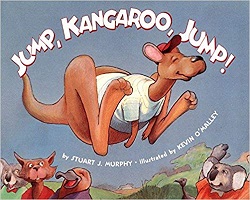
Game Time! + Jump, Kangaroo, Jump!: Compare tracking a continuous quantity with organizing discrete groups.
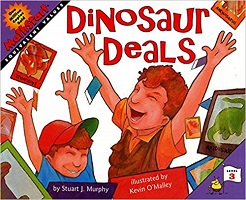
Dinosaur Deals + Shark Swimathon: Compare two situations where several numbers must be combined to make sense of progress or a deal.
Culminating discussion
Choose three books from different math domains and explain what everyday problem each turns into a mathematical one.
Teacher look-fors
Names the underlying quantity or relationship.
Chooses a strategy because of the problem, not because a worksheet says which operation to use.
Explains an answer in context.
Recognizes that different math domains can solve different kinds of everyday problems.
Existing-set duplication check
Closest existing Text Set: Counting stories
What overlaps: Both use story situations to make quantities and mathematical relationships meaningful. s
Why this set is genuinely different: Counting stories centers on counting and number ideas; Murphy's books range across comparison, equal shares, time, grouping, calculation, and tracking totals, with the everyday problem consistently creating the need for mathematics.