Circles, fractions, angles, area, graphs, and place value become problems characters have reasons to solve.
6 core booksGrades 3-5Catalogue reviewed
You are the teacher.
Use what works. Change what doesn’t. Make it yours.
Teaching purpose
Students compare how the Sir Cumference series embeds mathematical ideas inside recurring characters, quests, puzzles, and wordplay. The instructional goal is not to replace explicit math teaching; it is to notice how story can give a mathematical idea a memorable problem, image, and reason for being used.
Recommended grade band: Grades 3-5
The Big Question
What does a story add to a mathematical idea?
Source and confidence boundary
Titles, book IDs, authors, formats, and reading levels were checked against the updated TumbleBookLibrary Book_List.xlsx supplied for this build. Grade-band recommendations are instructional recommendations for the set, not catalogue claims about every individual title.
Standards status
This curated reading sequence is not itself a region-specific standards claim. Review the documentary status on any linked lesson plan.
Non Fiction / Math storyReading level 4.1Catalogue reviewed
Why it belongs: Cubes, pyramids, cylinders, and cones become part of a fantasy problem, with Euler's relationship connecting faces, edges, and vertices.
Unique contribution: It makes properties of solids useful evidence rather than a vocabulary list.
AskWhich property matters because of the problem, not just because a textbook would ask for it?
Why it belongs: A map-centered adventure combines spatial reasoning, mathematical clues, and the recurring quest structure.
Unique contribution: It closes with transfer: mathematics becomes one of several tools characters use to navigate a complex problem.
AskWhich part of the problem could not be solved by guessing alone?
Optional extensions
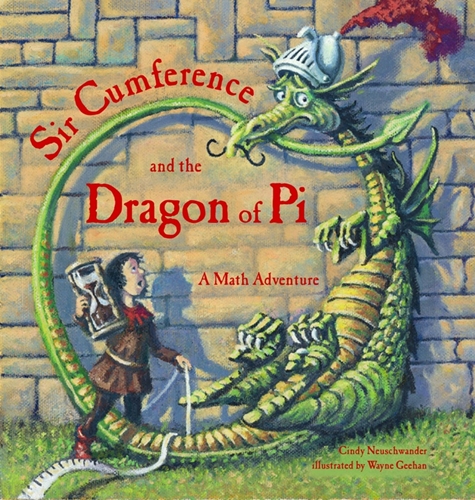
Sir Cumference and the Dragon of PiBook ID 8690Cindy Neuschwander · Catalogue reviewedWhy optional: A natural extension for circumference, diameter, and pi after students have enough circle vocabulary.
Sir Cumference and the First Round TableBook ID 8691Cindy Neuschwander · Catalogue reviewedWhy optional: Useful for circle properties and for discussing how the series turns mathematical language into names and plot.
Selection note: The core is limited to six titles so every book has a distinct job. The point of an author/series set is not to catalogue everything held; it is to make recurring craft, structure, or instructional design visible.
Across-the-set teaching moves
Write the story problem and the math problem side by side.
Identify the exact moment the characters need mathematics.
Ask what visual model the story supplies for the concept.
Separate mathematical accuracy from fantasy setting and wordplay.
After reading, restate the math idea without the story, then explain what the story helped you remember.
Book-to-book connections
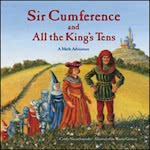
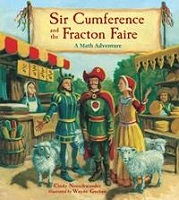
All the King's Tens + Fracton Faire: Compare grouping whole quantities with partitioning a whole into fractional parts.
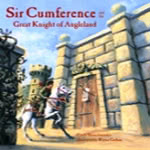
Great Knight of Angeland + Sword in the Cone: Move from angle relationships to three-dimensional geometry.
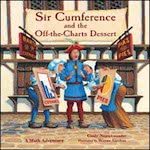
Off-the-Charts Dessert + Viking's Map: Compare mathematical representations used to make decisions and navigate information.
Culminating discussion
Choose three Sir Cumference books. For each, name the story problem, the mathematical idea, and the point where the mathematics becomes useful.
Teacher look-fors
States the mathematical idea precisely.
Explains why the character needs the mathematics.
Separates mnemonic story elements from the underlying concept.
Transfers the concept to a non-story example.
Existing-set duplication check
Closest existing Text Set: Shapes and patterns everywhere
What overlaps: Both use books to make mathematical structure visible through story and visual models.
Why this set is genuinely different: Shapes and patterns everywhere concentrates on recurring geometric and pattern ideas; this series ranges across place value, fractions, angles, solid geometry, data, and coordinates while showing how one sustained story world turns mathematics into plot.