Repetition, escalation, outrageous problems, strong voices, and sudden turns make stories easy to enter and hard to forget.
6 core booksGrades K-3Catalogue reviewed
You are the teacher.
Use what works. Change what doesn’t. Make it yours.
Teaching purpose
Students study recurring craft moves across Robert Munsch stories instead of reading the books as unrelated comic adventures. The sequence moves from repetition and escalation to character voice, independence, reversal, and finally a quieter story whose emotional purpose changes what readers expect from the author.
Recommended grade band: Grades K-3
The Big Question
What does Robert Munsch do again and again to make a story work aloud?
Source and confidence boundary
Titles, book IDs, authors, formats, and reading levels were checked against the updated TumbleBookLibrary Book_List.xlsx supplied for this build. Grade-band recommendations are instructional recommendations for the set, not catalogue claims about every individual title.
Standards status
This curated reading sequence is not itself a region-specific standards claim. Review the documentary status on any linked lesson plan.
Tell students they are looking for an author's habits. Keep a chart with five headings: repetition, bigger problem, character voice, surprise, and ending. Add evidence after every book.
Why it belongs: A child's experience of arriving in a new country brings fear, misunderstanding, language, and belonging into a more realistic register.
Unique contribution: It prevents an author study from reducing Munsch to comedy and shows how a recognizable storytelling voice can serve a serious experience.
AskWhat feels like the same storyteller, and what feels different because the purpose is different?
Optional extensions
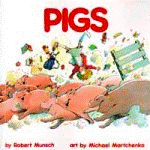
PigsBook ID 4195Robert Munsch · Catalogue reviewedWhy optional: A strong comic extension for escalation, chaos, and repeated consequences.
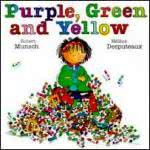
Purple, Green, and YellowBook ID 6801Robert Munsch · Catalogue reviewedWhy optional: Useful for exaggeration, visual comedy, and consequences that grow from one small choice.
Selection note: The core is limited to six titles so every book has a distinct job. The point of an author/series set is not to catalogue everything held; it is to make recurring craft, structure, or instructional design visible.
Across-the-set teaching moves
Mark each repeated phrase or situation, then identify what changes on the next repetition.
Ask when an ordinary problem becomes exaggerated enough to drive the story.
Read dialogue aloud in different voices and connect voice to character.
Predict the conventional ending before revealing how Munsch changes it.
Compare a comic title with From Far Away so students separate an author's craft habits from a single tone.
Book-to-book connections
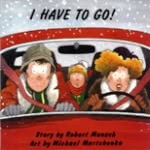
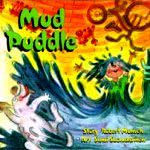
I Have to Go! + Mud Puddle: Compare repetition with repetition-plus-escalation.
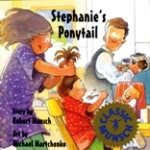
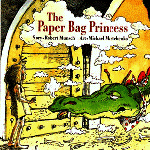
Stephanie's Ponytail + The Paper Bag Princess: Compare two characters who refuse to let other people decide who they should be.
Something Good + From Far Away: Compare how the same author handles misunderstanding for comedy and for belonging.
Culminating discussion
Choose three Munsch books and explain one craft move he repeats across them and one way he changes that move for a different story.
Teacher look-fors
Names a recurring author move with evidence.
Distinguishes repetition from escalation.
Explains how dialogue creates character voice.
Recognizes that an author can keep a recognizable style while changing tone and purpose.
Existing-set duplication check
Closest existing Text Set: Patterns and Repetition in Stories
What overlaps: Both attend to repetition, recurring episodes, and prediction.
Why this set is genuinely different: The existing set compares structures across many authors; this set studies how one author repeatedly combines repetition with voice, exaggeration, reversal, and performance.